
Your labs are normal — but you know your hormones are driving changes you're not okay with. Here's the test that finally asks the question your body is asking.
You know your body. You know the tiredness you wake up with isn't laziness. You know that losing your words mid-sentence isn't "just getting older," and that the cycle you have now isn't the one you had five years ago.
So you did the responsible thing. You asked for labs. And the results came back normal.
If you left that appointment feeling relieved and a little dismissed at the same time, you're not alone. "Normal" labs don't mean nothing is happening. Often they mean the test wasn't built to ask the question your body is asking.
That's where the DUTCH test comes in. It's the hormone test I recommend to women most — especially for the fatigue, brain fog, and hormone symptoms blood work can't explain. Here's what it is, what it shows, and, just as important, what it doesn't.
Why "normal" blood work can still leave you without answers
Blood work isn't wrong. It's answering a different question than the one you're asking. Three things get in the way.
A blood draw is one moment. Your hormones aren't still. Cortisol is meant to rise in the morning and fall through the day. Progesterone is released in pulses, so a single draw can catch a peak or a dip. One snapshot can look fine while the pattern across your day does not.
Reference ranges are wide. They're built to flag disease, not to describe how you function. You can sit inside the range and still be far from where your body feels its best. Functional lab work is different — it looks at how your body is working, not only whether disease is present.
Blood shows how much, not what happens next. A serum level tells you how much hormone is circulating. It doesn't tell you how your body is breaking that hormone down and clearing it, or what's actually being metabolized well. For a lot of women, that's where the story is.
So you can have real symptoms and a clean lab report at the same time. Both are true.
What the DUTCH test actually is
DUTCH stands for Dried Urine Test for Comprehensive Hormones. It comes from Precision Analytical, a lab in Oregon, and you do it at home.
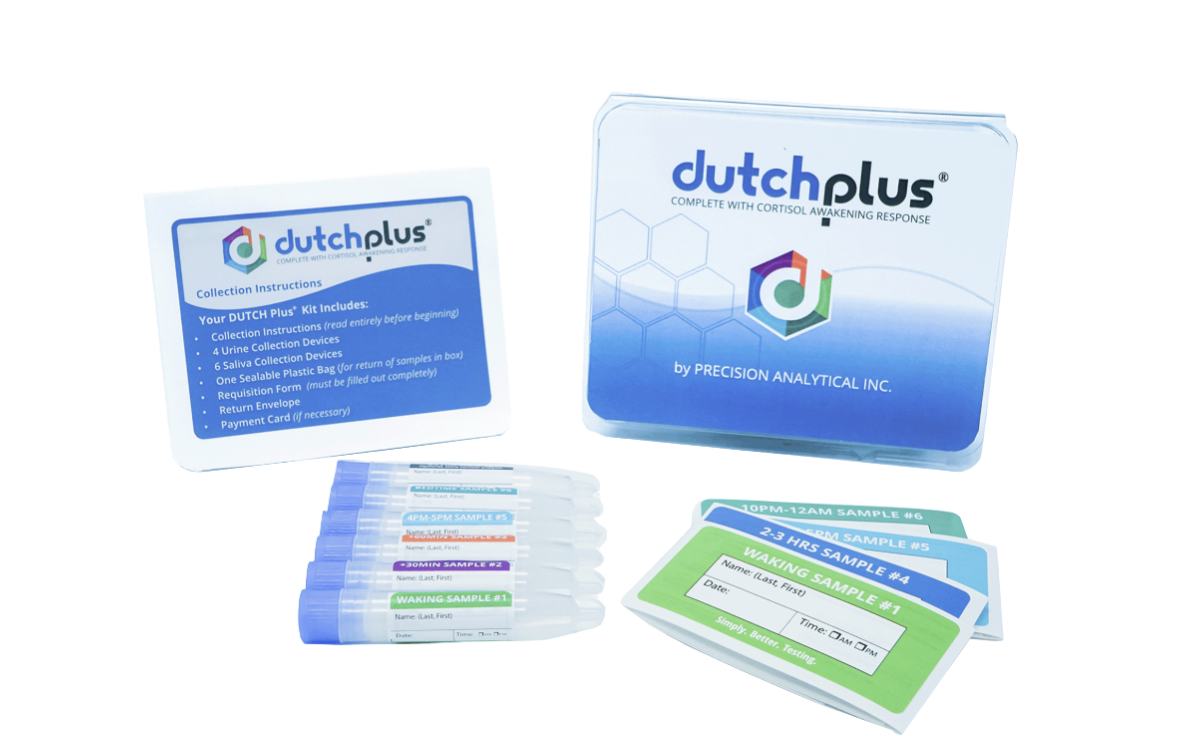
Instead of one blood draw, you collect four small urine samples on paper strips, plus a few saliva samples, over about 24 hours. The strips dry, you mail everything in, and the lab measures your hormones and the compounds your body turns them into.
That change in method matters. Each urine sample reflects hours of hormone activity, not a single minute. The waking sample alone covers your whole night. So instead of a snapshot, you get something closer to a short film of your day.
The version I use is the DUTCH Plus. It includes everything in the lab's DUTCH Complete — 35 hormones and metabolites — and adds saliva samples that capture your cortisol awakening response.
What it measures that a standard panel usually doesn't
The DUTCH Plus looks at four areas in one test. Most basic blood panels touch one or two of them, and only as single values.
| Area | What the test reports | What it adds |
|---|---|---|
| Stress hormones | Free cortisol and cortisone across the day, including the surge after waking, plus total metabolized cortisol | Your daily rhythm, your waking response, and your overall output, side by side |
| Sex hormones | Estrogens, progesterone metabolites, testosterone, DHEA-S | Levels reflected over hours instead of one moment |
| Hormone metabolism | The pathways your body uses to break down estrogen and androgens | How you process hormones, not only how much you make |
| Supporting markers | Overnight melatonin, an oxidative stress marker (8-OHdG), and six organic acids tied to B12, B6, glutathione, dopamine, and norepinephrine/epinephrine | Clues about sleep, nutrient status, and stress chemistry |
One note on cortisol. The cortisol awakening response is the rise in cortisol in the first 30 minutes or so after you wake. It shows how your stress system meets the day — and it's the reason I choose the DUTCH Plus over the DUTCH Complete.
How this connects to what you're feeling
These are patterns the test can point to, not diagnoses. They give us a place to start.
Fatigue. A single morning cortisol can look fine while your day tells a different story. The DUTCH Plus shows whether cortisol surges on waking the way it should and comes down by night. A flat morning, or cortisol that stays high at bedtime, often matches the "tired but wired" feeling so many women describe. It also shows whether your total output is low, high, or simply being cleared quickly.
Brain fog. Fog rarely has one cause. The test looks at several pieces at once: overnight melatonin, markers related to B12 and B6, and the breakdown products of dopamine and norepinephrine. Shifts in estrogen and progesterone, common in the years before menopause, can also show up here. Genetics matter, too — sometimes this piece gives us extremely valuable information about where the bottlenecks are in your system.
Hormone symptoms. Heavy or irregular cycles, PMS, sleep changes, hair and skin changes, low libido. A blood test may show estrogen "in range." The DUTCH adds how progesterone compares to estrogen in the second half of your cycle, and which pathways your body favors when it clears estrogen. That gives your symptoms a context a single number can't.
The most complete single picture of hormone patterns available right now.
Where the DUTCH test fits — and where it doesn't
I'd rather you trust this test for what it is than expect it to be everything. So here's the honest version.
It works alongside blood work. Thyroid, iron and ferritin, B12, vitamin D, and blood sugar are all blood tests — and each one is a common reason for fatigue and brain fog. If those haven't been checked, that comes first. There's a real place for blood labs, and they're often covered by your insurance. The DUTCH test isn't.
It doesn't diagnose. Medical conditions are diagnosed by your doctor, usually with blood testing. The DUTCH shows patterns that help guide support for your nervous system, nutrition, and daily rhythms — invaluable information that lights up the "unknown" areas of your hormone health.
The research is real, and still growing. In a 2019 study, dried urine results for estradiol and progesterone tracked closely with blood results. That study was small — 12 women — and funded by the lab that makes the test, and the authors themselves called for more validation on the other hormones. Not every clinician gives urine metabolite testing the same weight, and you deserve to know that.
What you take changes the reading. Hormonal birth control, hormone therapy, and some supplements affect results. Tell me what you're using before you test. I also have a free guide on what not to eat or take in the 48 hours before your test.
My own role is clear, too. I don't diagnose or prescribe. I use the DUTCH as a map — and when something on it needs medical follow-up, I'll send you back to your doctor with better questions.
What taking the test is like
The whole collection happens at home in about a day. No needles, no fasting blood draw, no waiting room.
- Order your kit. The DUTCH Plus is available through my Fullscript dispensary, and it ships to your door.
- Pick your day. If you're cycling, you collect in the second half of your cycle. The lab's cycle calculator gives your exact days. If you no longer have a cycle, any day works.
- Collect your samples. You saturate four paper strips with urine across the evening and morning. You also fill saliva tubes at set times, including right on waking and in the hour after. There's an optional extra saliva tube if you wake in the night.
- Let them dry and mail them. The kit includes a prepaid return envelope. Dried samples stay stable for weeks.
- Review the results together. The report is detailed. We go through it side by side so the numbers connect to your symptoms and your life.
My free guide covers what not to eat or take in the 48 hours before your test, and the kit's instructions cover collection day itself. Following both closely is what makes the results worth reading.
You weren't imagining it
If you've been told everything looks normal and you still don't feel like yourself, I believe you. What you're feeling is information. Your body isn't broken, and it isn't being dramatic.
In my work, a test like this is never the first layer. Your nervous system comes first, because a body that doesn't feel safe can't settle its hormones. The DUTCH simply shows us where to look, so the support you choose fits you. What I see again and again is that these patterns are completely shiftable once we can see them.
If you're curious whether the DUTCH test is a fit for you, I'd love to talk it through — no rush and no pressure. You can reach me through my chat or at helen@wholebodyandsole.com. And if you want to layer on genetic testing or a biofeedback scan, the best next step is a free discovery call.
Affiliate disclosure: I'm a Fullscript practitioner. If you order through my dispensary I may earn a small commission, at no extra cost to you.
This article is for education and isn't medical advice. Please talk with your healthcare provider about symptoms, testing, and treatment.
Frequently asked questions
Is the DUTCH test better than blood work?
It answers different questions. Blood work is the standard for diagnosing conditions like thyroid disease or anemia. The DUTCH adds your cortisol rhythm and how you metabolize hormones. Most women benefit from both.
Can the DUTCH test diagnose a hormone condition?
No. It shows patterns that guide support and help you ask better questions. Diagnosis belongs with your doctor.
When in my cycle should I take it?
In the second half of your cycle if you're cycling. The lab's calculator gives exact days based on your cycle length. Without a cycle, any day works.
Does birth control affect the results?
Yes. Hormonal birth control and hormone therapy both change the reading, so share what you take before you test.
What's the difference between the DUTCH Complete and the DUTCH Plus?
The Plus includes everything in the Complete and adds saliva samples that measure your cortisol awakening response. It's the version I use.
Written by Helen Parde, LMT — Integrative Health Facilitator at Whole Body and Sole, Herriman & South Jordan, Utah.