
You can eat your vegetables, drink your water, and still come up short on minerals. Here's why, and where humic and fulvic acid fit in.
I talk about minerals a lot. My favorite way to say it: all water is not created equal. Minerals are what help water actually get where it needs to go in your body. Without them, you can drink all day and still feel depleted.
So let's talk about where our minerals come from, why so many of us fall short, and what humic and fulvic acid are, those dark, earthy compounds that come straight from healthy soil.
Why minerals matter so much
Minerals aren't just "extra." They're the spark plugs for almost everything your body does. Take magnesium alone. According to the National Institutes of Health, it's a helper for more than 300 enzyme systems. Your body needs it to:
- Make energy (ATP) in your cells
- Relax muscles and keep nerves firing properly
- Regulate blood sugar and blood pressure
- Build bone, DNA, and glutathione, your body's master antioxidant
- Keep a steady heart rhythm
Minerals like sodium, potassium, and magnesium are also electrolytes. They help move water and nutrients into and out of your cells. That's why hydration is about more than how much water you drink.
Source: NIH Office of Dietary Supplements, Magnesium Fact Sheet
When was the last time the U.S. tested our soil?
You've probably seen the quote: "In 1936, the U.S. Senate warned that our soils were so depleted that 99% of Americans were mineral deficient." I went looking for that soil test, and here's what I found.
A 1936 U.S. Senate soil study proved our soil was depleted of minerals.
"Senate Document 264" was a reprinted Cosmopolitan magazine article by novelist Rex Beach. It was entered into the record, but it was never a government soil test.
Today, the USDA maps America's soils in great detail through its Web Soil Survey. But that's mostly about soil type, structure, and farming use. There's no national program that regularly tracks soil minerals to see what ends up in our food.
And here's the part that surprised me most. It isn't only the soil we've stopped checking. It's us.
National Health and Nutrition Examination Survey
1974 last time blood magnesium was measured
The national survey that tracks Americans' health hasn't measured blood magnesium since 1974. Magnesium isn't part of routine electrolyte tests in most hospitals and clinics either.
Sources: NIH Office of Dietary Supplements · Rosanoff, Weaver & Rude, Nutrition Reviews, 2012
Is our food really less nutritious?
Here, real data does exist. In 2004, researchers compared USDA nutrient data for 43 garden crops, mostly vegetables, from 1950 and 1999.
43 garden crops · 1950 vs. 1999
6–38% declines in 6 nutrients
Protein, calcium, phosphorus, iron, riboflavin (vitamin B2), and vitamin C all showed reliable drops. Riboflavin fell the most, at 38%.
So why did it happen? The researchers' best explanation wasn't worn-out soil. It was the crops themselves. Over those 50 years, farmers switched to varieties bred to grow bigger and faster. When a plant packs on more size and carbohydrate without taking up more minerals, every bite is a little more diluted. Scientists call this the "dilution effect."
We've bred food for size and shelf life, not for minerals.
Add in modern processing, like refining grains, which strips away the magnesium-rich germ and bran, and it's easy to see how a "normal" diet can come up short.
See the food nutrient studies
2004, J Am Coll Nutr: Comparing USDA data for 43 crops from 1950 and 1999, after adjusting for moisture, showed statistically reliable declines in 6 of 13 nutrients, ranging from 6% (protein) to 38% (riboflavin). The authors pointed to changes in crop varieties, a trade-off between yield and nutrients.
2017, J Food Compos Anal: A critical review agreed the main driver is the dilution effect in high-yield varieties. It noted that archived soil samples from intensively farmed, fertilized fields did not show declining mineral content, and that comparing old and new food data has real limitations.
How many of us fall short?
Americans of all ages · NHANES 2013–2016
48% get less magnesium than they need
Almost half of Americans take in less magnesium from food and drinks than the average daily requirement. Teens and men over 70 have the lowest intakes.
Low magnesium has been linked with type 2 diabetes, high blood pressure, heart disease, osteoporosis, migraines, and inflammation. Researchers have warned that the health effects of falling short may be underestimated, partly because we rarely test for it.
Sources: NIH Office of Dietary Supplements · Rosanoff et al., 2012
Anti-nutrients: it's not just what you eat
Here's another piece most people miss. Even when minerals are on your plate, some foods carry anti-nutrients that grab onto those minerals and carry them right out of your body before you can use them.
- Oxalates are found in spinach, almonds, beets, Swiss chard, and many "superfoods." They bind to minerals, especially calcium, and can form tiny crystals. I dig into how they affect energy, digestion, and the brain in Oxalates: The Hidden Superfoods Trying to Kill You.
- Phytates (phytic acid) are found in grains, beans, nuts, and seeds. They bind to iron, zinc, and other minerals and make them harder to absorb. Our bodies don't make the enzyme needed to break them down.
That doesn't mean these foods are bad. Many of them are nutrient-rich. But it means the green smoothie you drink every morning may be giving you less than you think, especially if you're already running low. Soaking, sprouting, fermenting, and cooking can all lower anti-nutrients and free up more minerals.
Sprouting and the old way of preparing grains
Our great-grandparents didn't eat grains the way we do. Traditional cultures soaked, sprouted, and fermented their grains, beans, and seeds before eating them. They may not have known the word "phytate," but they knew how to make grains easier on the body.
Some of that sprouting even happened right in the field. Before modern combines, wheat was cut by hand or by binder, tied into bundles, and stacked into "shocks" to dry in the field, often for days or weeks. With dew, rain, and warm days, some of those kernels began to sprout before the grain was ever threshed.
That came with a trade-off. Sprouted grain doesn't store as long, and it changes how flour bakes. Today, sprouting in the field is called pre-harvest sprouting, and modern agriculture treats it as a serious problem. Grain is harvested quickly by combine, and wheat breeders select for varieties that resist sprouting. That's great for shelf life and uniform bread. But it also means we lost a step that naturally made more of the grain's minerals available to our bodies.
What was a storage problem for the farmer was a nutrition bonus for the family.
Science now backs that wisdom up. When a seed starts to sprout, it switches on its own phytase, the enzyme that breaks down phytic acid, to free up minerals for the growing plant. That same process frees up more minerals for you.
- Soak: cover grains, beans, nuts, or seeds in warm water overnight, then rinse well before cooking.
- Sprout: after soaking, rinse and drain a few times a day until tiny tails appear. Then cook, dehydrate, or grind into flour.
- Ferment: traditional long-fermented sourdough gives natural microbes time to break down phytates.
- Shop smart: look for sprouted grain breads, sprouted flours, and sprouted rice or oats when you don't have time to do it yourself.
Want the step-by-step? Read Soaking and Sprouting Grains: The Old Way to Unlock Minerals, and grab my free Soaking & Sprouting Guide while you're there.
See the phytate research
A 2015 review explains that phytic acid, the main storage form of phosphorus in cereals, legumes, oilseeds, and nuts, chelates minerals like iron and zinc and keeps them from being absorbed, because humans lack the phytase enzyme. Fermentation, soaking, germination (sprouting), and enzyme treatment all reduce phytic acid and improve mineral availability.
Pre-harvest sprouting: A 2021 review describes pre-harvest sprouting, when grain germinates on the plant before harvest, as a serious global problem for grain quality and yield. It also notes that domesticated cereals generally have shorter dormancy than their wild ancestors, which makes them more prone to sprouting in wet weather.
What are humic and fulvic acid?
Pick up a handful of rich, dark garden soil. That dark color comes from humus, the end result of plants and organic matter broken down by soil microbes over time. Humic and fulvic acid are two of the main compounds in humus.
- Humic acid is the larger, darker molecule. It helps soil hold water and nutrients.
- Fulvic acid is smaller and lighter, and it dissolves in water at any pH. That makes it a natural mineral "carrier."
Both are natural chelators. That means they can grab onto mineral ions and hold them in a form that's easier to move around. In plants, this is well studied: humic substances help roots take up iron and other nutrients. That's why farmers use them to help crops grow.
See the plant research
A 2019 review in Frontiers in Plant Science explains how humic substances help plants absorb iron in two ways: by chelating (holding) iron so it stays available, and by stimulating the root's own iron-uptake machinery.
What the human research says
I want to be honest with you here, because the internet isn't always.
Fulvic acid has a long history in traditional medicine, and lab and animal research is genuinely interesting. Studies point toward possible benefits for inflammation, antioxidant activity, and gut health. A 2026 study found fulvic acid formulas were gentle on cells, calmed inflammatory signals, and encouraged beneficial gut bacteria like Lactobacillus in lab and animal models.
But large human trials haven't been done yet. A 2018 review summed it up well: research so far is minimal, but there's "substantial evidence to pursue" it, especially for chronic inflammation.
So here's how I think about it. Humic and fulvic acid are promising mineral carriers with good early science, not proven cures. You'll see product labels promise everything from DNA repair to EMF protection. I'd rather you know what's solid and what's still hopeful.
See the fulvic acid research
2018 review, J Diabetes Res: Researchers at the University of British Columbia reviewed the peer-reviewed research on fulvic acid's effects on the immune system, oxidative stress, and gut function. They concluded the research is limited but worth pursuing for chronic inflammatory conditions like diabetes.
2026 lab and animal study, Sci Rep: Fulvic acid formulas showed strong cell compatibility, low genotoxicity, suppression of inflammatory NF-κB signaling, and growth of beneficial gut bacteria. The authors called for further translational studies.
The fulvic mineral supplement I recommend
For a simple way to add trace minerals along with fulvic and humic acid, I recommend Solex Gold. It's a liquid blend of fulvic acid, humic acid, and more than 70 naturally occurring trace minerals and electrolytes.

- How to take it: Solex suggests 4 to 5 droppers in 10 ounces of water.
- A heads up on taste: it's earthy. Mixing it into juice or a flavored drink helps a lot.
- Start low: begin with a smaller amount and build up so your body can adjust.
Food first: easy ways to add minerals
Supplements work best on top of a mineral-rich plate. Some of the best magnesium sources, according to the NIH:
Magnesium-rich foods
- Pumpkin seeds, 1 oz156 mg
- Chia seeds, 1 oz111 mg
- Almonds, 1 oz80 mg
- Spinach, boiled, ½ cup78 mg
- Cashews, 1 oz74 mg
- Black beans, ½ cup60 mg
A few more tips:
- Choose whole grains over refined ones, since refining removes most of the magnesium.
- Mind your water. Mineral content in tap and bottled water varies hugely, from about 1 to more than 120 mg of magnesium per liter.
- Watch the spinach and almonds. Both are high in magnesium, but also in oxalates (see the anti-nutrients section above). Rotate your greens and see my oxalates post for lower-oxalate swaps.
- Soak, sprout, or ferment grains, beans, and seeds when you can to lower phytates.
- Re-mineralize after detox. If you use binders, they can pull minerals along with toxins. See Binders for Detox.
A few safety notes
- Talk to your provider first if you're pregnant or breastfeeding, have kidney disease, or take prescription medications. Mineral supplements and chelating compounds aren't right for everyone.
- Quality matters. Anything that comes from soil can also carry what's in that soil, so choose brands you trust.
- Notice how you feel. Some people notice digestive changes when they start. Scale back if needed.
Your genes matter too
Two people can eat the exact same plate of food and get very different amounts of minerals out of it. Part of the reason is genetics.
Your body uses specific genes to build the transporters and enzymes that absorb, move, and use each nutrient. Small variations in those genes can make one person's system run smoothly while another person's needs extra support for the same nutrient.
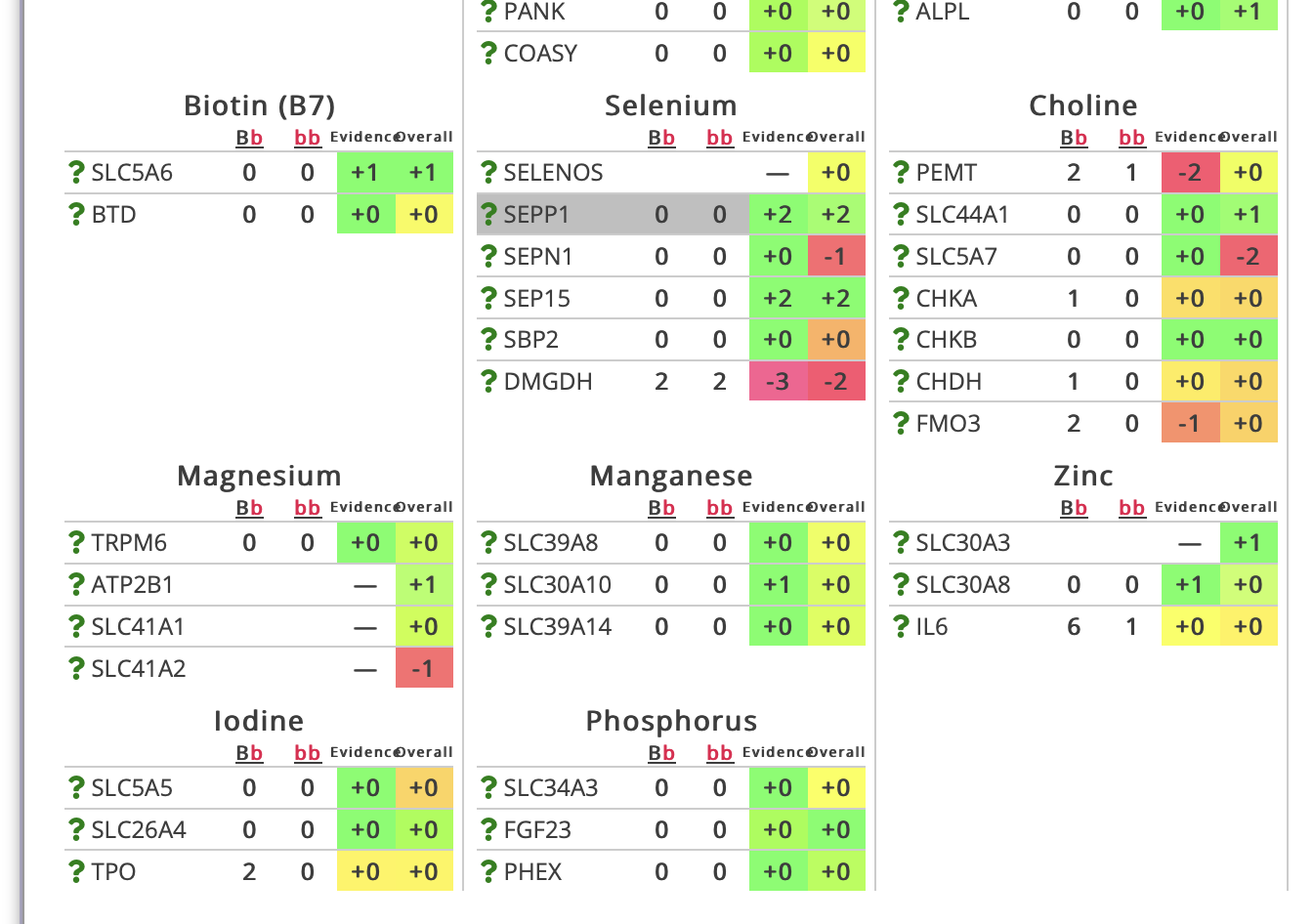
This is a section from the kind of report I walk through with clients. Each row is a gene tied to a specific nutrient, like the transporters that move biotin and choline into your cells. The color-coded scores show where your genes are likely working in your favor (green) and where you may need more support (yellow and pink).
That's the power of Functional Genomics Testing. Instead of guessing which minerals and nutrients you need more of, we can see where your body is likely to struggle and build a plan around your blueprint.
But here's the thing: genes are the blueprint. Minerals are the building materials.
You can have the most beautiful set of blueprints in the world, but if no lumber shows up, the house doesn't get built. If you don't have the raw materials, it doesn't matter how sound your genetics are. Your body can't make energy, calm a nerve, or build glutathione out of minerals it doesn't have.
And it works the other way too. If your genes make it harder to absorb or use a nutrient, simply eating "enough" may not be enough for you. That's why I look at both: the blueprint and the building blocks.
Where this leaves us
Our food has changed. Many of us aren't getting the magnesium and other minerals our bodies run on, and almost no one is checking. That doesn't mean panic. It means paying attention: eat mineral-rich foods, rethink your water, consider a gentle mineral boost if it fits your body, and get to know your own genetic blueprint so you know what your body needs most.
Humic and fulvic acid are nature's way of carrying minerals through healthy soil. The human research is still young, but it's an exciting place to watch, and a simple daily ritual for those of us who want our water to work harder.
Written by Helen Parde, Integrative Health Facilitator at Whole Body and Sole, Herriman & South Jordan, Utah.